If you’ve been reading about sermorelin and testosterone, you’ve probably seen them lined up against each other like you have to pick one. That framing is doing you a disservice. They treat different problems, and a lot of the men we prescribe for end up on both.
Short version
- Testosterone therapy replaces testosterone your body isn’t making enough of. It’s for men whose bloodwork shows a testosterone deficiency. In those men it raises low sex drive, shifts body composition toward less fat and more lean mass, and improves overall well-being. Mood improved too, by less.
- Sermorelin prompts your pituitary to release more of your own growth hormone. In trials it raised IGF-1, the blood marker growth hormone works through, cut body fat, added lean mass and improved several measures of thinking.
- They work on separate systems. Growth hormone given for six months didn’t move testosterone at all. Nobody has tested sermorelin and testosterone together.
- Sermorelin won’t fix low testosterone, and it isn’t meant to. If your levels are genuinely low, that’s a testosterone conversation.
- Testosterone therapy quiets your own testosterone production while you’re on it. That’s expected and it’s measurable. hCG is an injection that stands in for the pituitary signal your body switches off, and it keeps testosterone inside the testicle in the normal range. The higher the hCG dose, the better it holds.
- Plenty of men are on both, because fixing one hormone doesn’t do the other one’s job.
What each one is actually for
Testosterone replacement therapy, TRT, puts back the testosterone your body has stopped making enough of. We have to see it on your bloodwork before we prescribe it, which is why treatment starts with labs and a consult rather than a questionnaire.
Sermorelin is aimed at a different hormone entirely. It’s a growth hormone-releasing hormone analog, meaning a synthetic copy of the signal your hypothalamus already sends. It tells your pituitary to release more of your own growth hormone. Men take it for recovery, for body composition, meaning the balance of fat and muscle, and for how they feel physically as they get older.
There’s no FDA-approved sermorelin product in the US right now. That said, licensed pharmacies are allowed to compound it for you, which is how you’d get it: a small vial mixed to order, injected at home. No FDA approval sounds scarier than it is. It means the agency has not reviewed this particular preparation, not that anybody found a problem with the drug. We go through that in sermorelin vs tesamorelin.
How each one works
They run on two separate control loops.
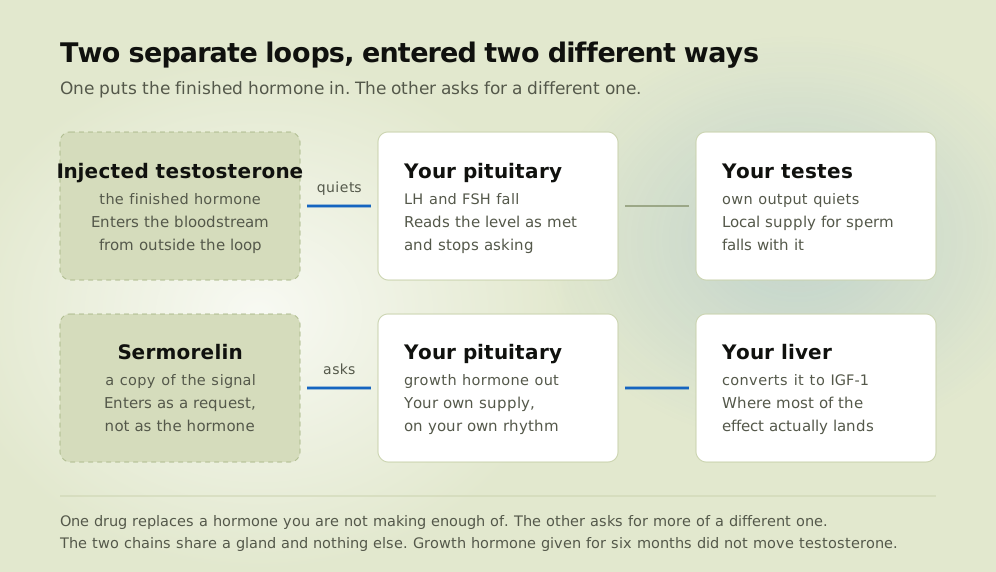
Your testosterone runs on what’s called the HPG axis. Your hypothalamus signals your pituitary, your pituitary releases two signaling hormones called LH and FSH, and those tell your testes to make testosterone and sperm. When you inject testosterone, you’re adding the finished hormone directly to your bloodstream and skipping the whole chain.
Over on the other end of the pituitary, sermorelin binds a different receptor. That signal tells the pituitary to release growth hormone, and your liver converts that into IGF-1, the messenger most of growth hormone’s effects actually run through. You’re not adding the hormone. You’re asking for more of it.
One puts the hormone in, the other asks your body for more of a different one. That’s why they don’t cancel each other out, and why neither replaces the other.
What each one has been measured to do
Sex drive comes back. In 470 men followed for a year, testosterone beat placebo on 10 of 12 measures of sexual activity. And the lower you start, the more you get back: across 14 trials and 2,298 men, the effect roughly doubled in the men whose levels started furthest below the normal range.
Body composition moves too. Across 29 trials and 1,083 men, testosterone took off about three and a half pounds of fat and put on about the same in lean mass, with no change in body weight at all. A three-year trial found the same shape: nearly seven pounds of fat lost against a pound and a half on placebo.

Men describe feeling more like themselves. Across five trials and 1,212 men, symptom scores improved, including the physical ones covering exhaustion and sleep. In 136 men treated surgically for low-grade prostate cancer and followed for twelve weeks, testosterone beat placebo on well-being, physical function and measured aerobic fitness. And across 790 men in the Testosterone Trials, mood and depressive symptoms came out slightly better than on placebo.
Testosterone also raises your red blood cell count. In the 62 men in the Testosterone Trials who were anemic for no identifiable reason, 54% raised their hemoglobin by at least a full point over a year, against 15% on placebo. In a man whose count was already normal, the same effect can push it above the normal range and thicken the blood. That’s why a CBC is on your starting panel and why we recheck it on therapy.
On safety, the largest trial put 5,246 men with existing cardiac risk on daily testosterone gel or placebo and found major cardiac events in 7.0% against 7.3%. In plain terms, being on testosterone did not raise their cardiac risk. On the back of it, the FDA directed class-wide labeling changes in February 2025. The cardiovascular boxed-warning language came off. A new warning about raised blood pressure went on, and the line saying the drug isn’t established for age-related low testosterone stayed. That said, the trial did see more atrial fibrillation, an irregular heartbeat, and a pooled analysis of 23 trials including this one found the same for irregular heartbeats generally. It’s one of the reasons we recheck bloodwork on therapy rather than writing a prescription and leaving you to it.
Sermorelin works on a different hormone. Over six months it raised IGF-1, the marker growth hormone works through, by 40% in men and 30% in women not on estrogen replacement. Body fat fell by about 5% of what the men were carrying, and lean mass rose to match. And in 89 older adults on a nightly dose, it beat placebo on five separate tests of thinking: problem solving, attention, visual scanning, verbal fluency and switching between two tasks at once.
Nobody has run a trial putting the two drugs head to head, so anyone ranking them is giving you an opinion.
What testosterone does to your own production, and what we do about it
Here’s the thing. When you inject testosterone, your body stops making its own. The signals from your pituitary switch off, your testes go quiet, and over time that can mean smaller testicles and reduced fertility. That’s why we ask about children in the first consultation.
It’s measurable. Three weeks of weekly testosterone dropped the two pituitary signals to 5% and 3% of where they started, and testosterone inside the testicle itself, which is what drives sperm production, to about 6%. A normal testosterone reading on a blood test won’t tell you any of that.

So we don’t pretend that isn’t happening. We counteract it. The same study that measured the shutdown also tested the fix. hCG is an injection that stands in for the pituitary signal testosterone switches off, and men given it alongside their testosterone kept the level inside the testicle within the normal range. The higher the dose, the better it held. That’s why a lot of men on testosterone run hCG alongside it, which is an approved drug being used off-label for this. For some that’s about protecting fertility. For plenty of others it’s simply not wanting their testicles to shrink, which is what happens when the signal switches off.
Testosterone is most commonly prescribed as an injection. If needles are the problem, two of our options aren’t. Kyzatrex is FDA-approved testosterone you take by capsule. Enclomiphene is a tablet, and we prescribe it too. It isn’t FDA-approved and comes from a compounding pharmacy, same as sermorelin.
You don’t have to cycle off testosterone. Plenty of men stay on it long term, and that’s a normal way to run it. If you do come off, your own production restarts: across 30 trials of hormonal male contraception in 1,549 men, sperm counts were back to normal in 67% of men by 6 months, 90% by 12 months and 100% within 24. If you’d rather not do that alone, we offer post-cycle therapy: a short protocol run with a provider while your own production comes back.
If you’re actively trying to conceive right now, say so on the consult. It changes what we’d prescribe, and it’s a conversation to have before anything starts.

Hormone Therapy
Testosterone Replacement Therapy
Replacement therapy for men with diagnosed low testosterone, with labs, dosing and monitoring handled by our clinicians.
From $99/mo annually
Florida residents only.
Who needs which, and who needs both
Start with what’s bothering you, then confirm it with labs. Not the other way round.
| What you’re noticing | What it points at | What gets checked |
|---|---|---|
| Low sex drive, low mood, losing strength | Testosterone | The starting panel below |
| Testosterone already normal, but recovery is slow, fat is up and muscle is down | Growth hormone | IGF-1 |
| Testosterone corrected, symptoms better, recovery still lagging | Both | IGF-1, with testosterone rechecked on therapy |
| Trying to conceive | Neither, yet | Semen analysis before anything starts |
That third row is the one we see most. A man gets his testosterone into range, and the libido and the mood come back. Six months later he still isn’t recovering between sessions, and his body composition hasn’t moved the way he expected. His testosterone isn’t the problem anymore.
How they’re prescribed together
We prescribe both together where both apply, because they work on different hormones and don’t compete: you get two things handled instead of treating one and waiting to see about the other. Plenty of men still start with testosterone alone, and that is a reasonable place to start. To be straight with you: no published or registered trial has given both to the same patients, so that recommendation rests on how each drug works, not on a trial that tested the pair.
Testosterone is the one you’ll notice first, in weeks. Sermorelin is a small nightly injection under the skin, timed for when your own growth hormone pulses, and it builds over months.
Starting TRT with us takes four labs: total testosterone, a CBC, PSA and total estradiol. The CBC covers your blood count, which testosterone can push up. PSA is a prostate marker we want a baseline on. Estradiol is the estrogen some of your testosterone converts into, and it needs to stay in range. For sermorelin we track IGF-1.
Wellness & Longevity
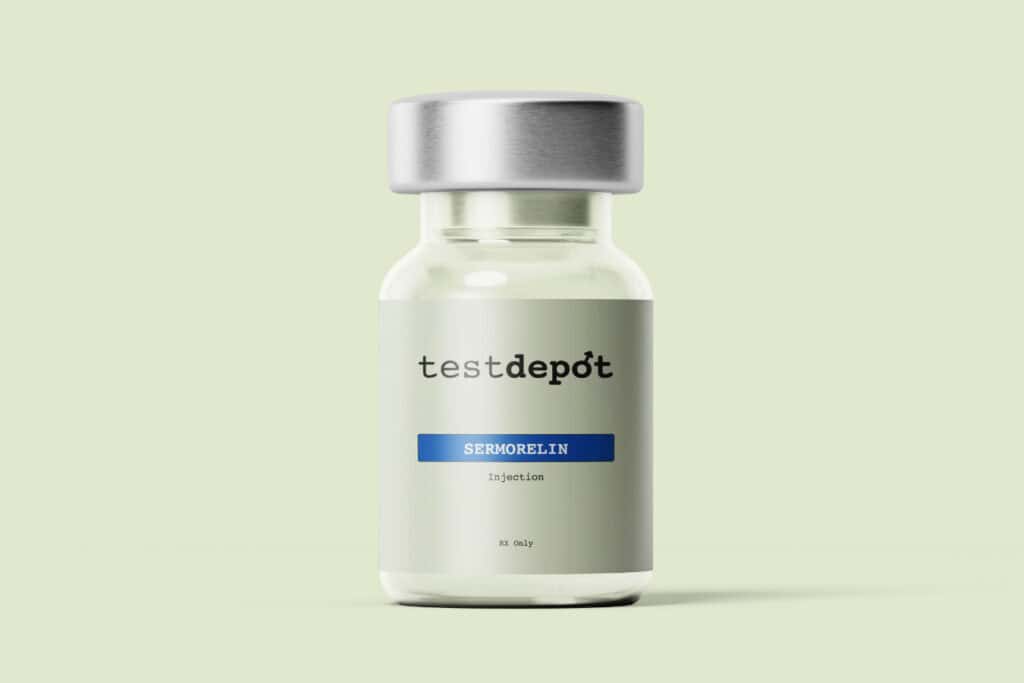
Sermorelin
Compounded sermorelin for men who want to support their own growth hormone, prescribed and monitored by our clinicians.
From $259 every 6 weeks
Florida residents only.
FAQ
Is peptide therapy better than TRT?
They treat different things, so the comparison doesn’t really apply. Testosterone is for a
measured testosterone deficiency. Sermorelin supports growth hormone, which is a different
system with different complaints attached to it. The useful question is which one your labs and
symptoms point at, and for plenty of men the answer is both.
Can I use TRT and sermorelin together?
Yes, and it’s common. They act on separate systems, and growth hormone didn’t move testosterone in
the one trial that looked. The men who run both are usually the ones whose testosterone is
already corrected and who want the recovery and body-composition side handled too.
Does sermorelin raise testosterone?
No. Researchers gave 48 older adults growth hormone for six months, which is a stronger
intervention than sermorelin. IGF-1 rose. Testosterone didn’t move, and neither did the hormones that travel with it. So if your testosterone is low, sermorelin isn’t the answer
to it.
Will sermorelin make me bigger?
Honestly, not the way you’re picturing. Lean mass and strength aren’t the same measurement: a
scan counts muscle, water and organs together, so lean mass rising is not proof that strength
follows. The sermorelin program measured strength directly, and it didn’t improve.
What are the downsides of sermorelin?
An active cancer rules it out. Growth hormone tells cells to grow, and tesamorelin and growth hormone itself, which both have current FDA prescribing information, exclude anyone with an active cancer (tesamorelin, growth hormone). Sermorelin has no label of its own, and the same rule applies because it raises the same hormone. A cancer you’ve been treated for is a different question: those labels ask that it be inactive and the treatment finished, and that a doctor weigh the risk with you first. So tell your provider if you’ve had cancer.
The everyday side effects are local: redness, swelling or itching where you inject. The bigger limitations
are about what nobody has measured. There’s no FDA-approved product in the US, and no adult trial of sermorelin has run past six months, so what happens after that is unknown rather than known to be bad. Drugs in this class have also shown effects on blood sugar and insulin in some studies and
not others, which is why we check it rather than assume it.
Do I need bloodwork before starting either one?
Yes, and it isn’t optional. Starting TRT with us takes total testosterone, a CBC, PSA and total
estradiol, with the testosterone drawn in the morning. For sermorelin we check your testosterone
first either way, because low testosterone explains most of the symptoms men arrive with.
Related reading
- Sermorelin vs tesamorelin, on why only one of the two can be compounded for you at all.
- Sermorelin vs ipamorelin, on two peptides that hit different receptors and are constantly treated as interchangeable.
- Testosterone replacement therapy at TestDepot, what we prescribe, how it’s monitored and what it costs.
References
- Testosterone Cypionate Injection, USP prescribing information. Hikma Pharmaceuticals USA, DailyMed, revised June 2025. Source of the approved indications and of the age-related hypogonadism limitation.
- Testosterone Treatment and Sexual Function in Older Men With Low Testosterone Levels. Cunningham GR, Stephens-Shields AJ, Rosen RC, et al. Journal of Clinical Endocrinology & Metabolism, 2016;101(8):3096–3104. Four hundred and seventy men, twelve months. Source of the finding that testosterone improved 10 of 12 measures of sexual activity. Part of the Testosterone Trials, seven questions asked of one group of 790 men.
- Meta-analysis of Results of Testosterone Therapy on Sexual Function Based on International Index of Erectile Function Scores. Corona G, Rastrelli G, Morgentaler A, et al. European Urology, 2017;72(6):1000–1011. Fourteen trials, 2,298 men. Source of the 1.47 and 2.95 point gains and of the finding that the effect is larger the lower the starting level.
- Effects of testosterone on body composition, bone metabolism and serum lipid profile in middle-aged men: a meta-analysis. Isidori AM, Giannetta E, Greco EA, et al. Clinical Endocrinology, 2005;63(3):280–293. Twenty-nine trials, 1,083 men. Source of the 1.6 kg figures and of the finding of no change in body weight.
- Effect of testosterone treatment on body composition and muscle strength in men over 65 years of age. Snyder PJ, Peachey H, Hannoush P, et al. Journal of Clinical Endocrinology & Metabolism, 1999;84(8):2647–2653. One hundred and eight men, thirty-six months. Source of the 3.0 kg against 0.7 kg fat loss, and of the finding that measured knee strength did not change.
- Association of Testosterone Levels With Anemia in Older Men: A Controlled Clinical Trial. Roy CN, Snyder PJ, Stephens-Shields AJ, et al. JAMA Internal Medicine, 2017;177(4):480–490. Source of the 54% against 15% haemoglobin response, in the 62 men with anaemia of no identifiable cause. Same 790-man cohort as the sexual-function trial above.
- Testosterone replacement therapy improves health-related quality of life for patients with late-onset hypogonadism: a meta-analysis of randomized controlled trials. Nian Y, Ding M, Hu S, et al. Andrologia, 2017;49(4):e12630. Five randomised trials, 1,212 men, Aging Males’ Symptom rating scale. Source of the improvement in overall symptom score and in the physical domain.
- Testosterone Treatment in Prostate Cancer Survivors With Hypogonadism: A Randomized Clinical Trial. Bhasin S, Burnett AL, Gagliano-Jucá T, et al. JAMA Internal Medicine, 2026;186(7):805–814. One hundred and thirty-six men, twelve weeks, placebo-controlled. Source of the improvements in well-being, physical function and aerobic performance. Participants were men treated surgically for low-grade prostate cancer.
- Effects of Testosterone Treatment in Older Men. Snyder PJ, Bhasin S, Cunningham GR, et al. New England Journal of Medicine, 2016;374(7):611–624. The Testosterone Trials. Source of the improvement in mood and depressive symptoms. Seven questions asked of one group of 790 men, which is also the source of the sexual-function and anaemia findings above.
- Cardiovascular Safety of Testosterone-Replacement Therapy. Lincoff AM, Bhasin S, Flevaris P, et al. New England Journal of Medicine, 2023;389(2):107–117. TRAVERSE, n=5,246. Source of the 7.0% versus 7.3% event rates and of the atrial fibrillation, kidney injury and pulmonary embolism findings.
- Long-term cardiovascular safety of testosterone-replacement therapy in middle-aged and older men: a meta-analysis of randomized controlled trials. American Journal of Cardiovascular Drugs, 2025;25(6):767–777. Twenty-three randomised trials, 9,280 men. Source of the pooled finding of more cardiac arrhythmia on testosterone; this analysis includes TRAVERSE among its 23 trials.
- FDA issues class-wide labeling changes for testosterone products. US Food and Drug Administration, 28 February 2025. Source of the boxed-warning removal, the new blood pressure warning and the retained limitation of use.
- Low-dose human chorionic gonadotropin maintains intratesticular testosterone in normal men with testosterone-induced gonadotropin suppression. Coviello AD, Matsumoto AM, Bremner WJ, et al. Journal of Clinical Endocrinology & Metabolism, 2005;90(5):2595–2602. Source of the LH, FSH and 94% intratesticular testosterone figures, the 1.2% serum-to-testis ratio, and the hCG dose response.
- Rate, extent, and modifiers of spermatogenic recovery after hormonal male contraception: an integrated analysis. Liu PY, Swerdloff RS, Christenson PD, et al. The Lancet, 2006;367(9520):1412–1420. Thirty trials, 1,549 men. Source of the recovery percentages and the 3.4-month median.
- Effects of growth hormone administration on luteinizing hormone secretion in healthy older men and women. Muniyappa R, Sullivan SD, Tella SH, et al. Physiological Reports, 2017;5(23):e13516. Forty-eight adults, 26 weeks. Source of the finding that growth hormone did not change testosterone, free testosterone, estradiol, SHBG or LH.
- Treating age-related changes in somatotrophic hormones, sleep, and cognition. Vitiello MV, Moe KE, Merriam GR, Mazzoni G, Bulcroft KA, Schwartz RS. Dialogues in Clinical Neuroscience, 2001;3(3):229–236. Source of the IGF-1 rise of about 40% in men and 30% in women, and of the body-fat and lean-mass figures. The same program measured strength and aerobic fitness directly and neither improved, which is the source of the strength answer in the FAQ. The authors report the body-composition figures as preliminary results from a study that was still running.
- Growth hormone releasing hormone improves the cognition of healthy older adults. Vitiello MV, Moe KE, Merriam GR, et al. Neurobiology of Aging, 2006;27(2):318–323. Six months, 89 adults. Source of the five improved cognitive measures.
- Growth Hormone Releasing Hormone (GHRH) Treatment for Age-Related Sleep Disturbances. ClinicalTrials.gov, NCT00000380. One of the 42 registered sermorelin studies checked when confirming that no published or registered trial has given a GHRH analog and testosterone to the same patients.
- EGRIFTA WR (tesamorelin for injection) prescribing information. US Food and Drug Administration, revised March 2025. Source of the contraindication in active malignancy, the requirement that a preexisting malignancy be inactive and its treatment complete, and the careful-evaluation warning for a treated, stable cancer.
- Genotropin (somatropin) prescribing information. Pfizer. Source of the growth hormone class contraindication in active malignancy and of the requirement that a preexisting malignancy be inactive and its treatment complete before therapy begins.
This article is for general information and is not individual medical advice. Sermorelin and testosterone therapy are prescription medicines; whether either is appropriate for you depends on your labs, your history and a clinician’s judgment. Talk to a clinician before starting or stopping any treatment.