If you’ve been reading about peptides for recovery, body composition or sleep, you’ve seen sermorelin and ipamorelin sold beside each other. Often in the same vial. They get described as two versions of the same idea.
They aren’t. They work on two different receptors, they carry very different amounts of human evidence, and only one of them is something a pharmacy can actually make for you.
Both are trying to do the same job: get your pituitary to release more of your own growth hormone.
Here’s the thing. The difference has nothing to do with which one is stronger. No published study has tested ipamorelin in people as a shot under the skin, which is how clinics prescribe it.
Short version
- Both drugs are meant to get your body making more of its own growth hormone. They go about it through two different doorways. Sermorelin uses the same signal your body already sends. Ipamorelin goes in through the receptor that normally handles hunger.
- What sermorelin has been measured doing. IGF-1 is the growth factor your liver makes in response to growth hormone. In healthy older adults it rose about 40% in men, 30% in women not on estrogen replacement, and under 10% in women who were. Body fat fell about 5% in those same two groups, and lean mass rose to match (Vitiello et al., 2001). Thinking-test scores beat placebo over six months (Vitiello et al., 2006).
- What ipamorelin has been measured doing: recovery of bowel function after surgery. That is the only condition anyone has tested it for in people, and it made no measurable difference. Nobody has studied it for anti-aging at all.
- Nobody has tested ipamorelin the way clinics prescribe it. Every trial injected it into a vein. Clinics sell it as a shot under the skin, and the FDA says there is no data at all for that (FDA, 2024).
- A pharmacy can make sermorelin for you. No pharmacy can legally make ipamorelin. That comes down to FDA’s compounding rules, not to anyone’s opinion of the drug. The rules are below.
- We prescribe sermorelin, because it has been studied in people like you, by the route you would use, and a pharmacy can legally make it. None of those three is true of ipamorelin.
They work on two different switches
Your pituitary gland releases growth hormone when it gets told to. There are two separate signals that can do the telling, and this is where these drugs part company.
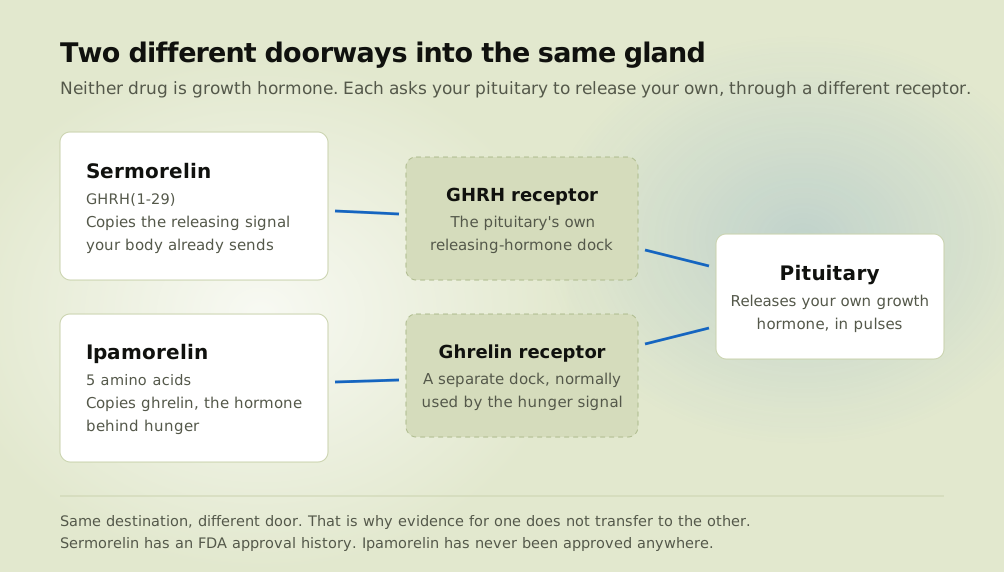
Sermorelin is a GHRH analog, and it copies the first signal. It’s GHRH(1-29), a shortened version of growth hormone releasing hormone, the message your hypothalamus already sends. It docks at the GHRH receptor, so your pituitary responds the way it would to your own signal.
Ipamorelin copies the second signal. It’s a five-amino-acid chain that imitates ghrelin, the hormone best known for making you hungry, and it docks at the ghrelin receptor, not the one sermorelin uses (FDA, 2024).
So there are two different signals, and one result: a pulse of your own growth hormone.
There’s a third drug people weigh alongside these two. Tesamorelin is a GHRH analog like sermorelin, but no pharmacy can make it either, for an entirely different reason. The FDA moved it into the biologic category in 2020 (FDA, 2020), and biological products are “not eligible for the exemptions for compounded drugs”. That one gets its own page: sermorelin vs tesamorelin.
Ipamorelin’s makeup matters for a practical reason. It contains unnatural amino acids, meaning building blocks your body doesn’t make. The FDA flags this directly: “less is known about the safety and biological properties of peptides that contain unnatural amino acids.” Sermorelin is built from ordinary ones.
You’ll also read that ipamorelin is the “selective” one, that it lifts growth hormone without raising cortisol or prolactin. That finding is real, and it comes from animal work. The source is a 1998 paper measuring cells in a dish, rats and pigs (Raun et al., 1998). No human study has ever measured it. Granted, the claim may well hold up in people. Nobody has checked.
What each one is actually for
Sermorelin
Sermorelin is prescribed to raise your own growth hormone. People usually take it for body composition, recovery and how sharp they feel. What the trials actually measured, in healthy older adults:
IGF-1 goes up, and how much depends on who you are. In a University of Washington program using nightly sermorelin acetate, IGF-1 rose about 40% in men and about 30% in women not taking estrogen replacement. In women who were on estrogen replacement it rose under 10% (Vitiello et al., 2001).
Body fat fell. DEXA scanning is the X-ray body scan that separates fat from muscle and bone. On it, percentage body fat dropped about 5% in the men and in the women not on estrogen replacement, with a matching rise in lean body mass, which counts muscle, water and organs together (Vitiello et al., 2001).

Thinking-test scores improved. In a six-month randomized placebo-controlled trial in 89 healthy older adults, mean age 68, the treated group beat placebo on five separate tests of thinking (Vitiello et al., 2006). The tests covered problem solving, attention, visual scanning, verbal fluency and switching between two tasks.
What it has not been shown to do: improve sleep, build muscle or strength, or work as a substitute for growth hormone itself. No adult trial of sermorelin has run past six months.
It’s a small injection under the skin, at night.
Sermorelin’s own side-effect record is thin. Nobody has built a modern safety database for it, so what follows is the closest evidence there is. In the closest adult trial, 19 people injecting a close analog nightly for five months, the only adverse effect was a temporary rise in blood fats, which resolved (Khorram et al., 1997).
The catch is blood sugar. Sermorelin itself didn’t change fasting glucose when healthy older men injected it twice a day for two weeks (Corpas et al., 1992). That said, a long-acting relative, given repeatedly to older adults, made it somewhat harder for their bodies to handle sugar (Munafo et al., 2005). So if you’re diabetic or prediabetic, tell your provider before you start.
Cancer rules this out. Growth hormone tells cells to grow, so tesamorelin and growth hormone itself, which both have current FDA prescribing information, say no to anyone with an active cancer (tesamorelin, growth hormone). A cancer that has been treated and is stable is not an automatic no, but it needs a doctor’s evaluation first. Sermorelin has no FDA prescribing information of its own, and the same rule applies because it raises the same hormone.
Ipamorelin
The FDA’s own review notes ipamorelin “has been marketed for use in weight loss management, anti-aging, inflammatory conditions, sleep cycle improvement, and bodybuilding” (FDA, 2024).
One trial of ipamorelin has ever been published, and it was about recovery of bowel function after surgery. Nothing on the registry tests it for weight, aging, sleep or muscle. One of the other two entries is an observational study that lists it among the supplements its 52 participants took, with no dose or route recorded (NCT07717866).
So the list of things it is sold for and the list of things it has been tested for do not overlap at a single point.
And no trial has ever compared the two drugs directly. Not one. Anyone telling you which is stronger, gentler or faster is telling you something no study has measured.
What ipamorelin has been tested on
The one published trial injected it into a vein.
What it tested. One hundred and seventeen people recovering from bowel surgery were given ipamorelin or a placebo, to see whether their digestion restarted sooner. It didn’t. They got back to solid food about seven hours ahead of placebo, a difference too small to mean anything in a group that size (Beck et al., 2014).
The trial’s other measures came out the same way: time to a first bowel movement, readiness to go home, and length of stay.
That is the whole record in patients. Nobody has measured body fat, lean mass, workout recovery, sleep or energy.
The route nobody has studied
The only other human data comes from a pharmacology study in healthy men, given ipamorelin as a short infusion into a vein (Gobburu et al., 1999). Growth hormone rose, peaked within the hour, and was back near baseline by the end of the day. That is what a single dose does in a healthy person, and it is the only time anyone has measured it.
That dose went into a vein, and so did every dose in the trial before it.
Clinics prescribe it as a shot under the skin. On that route, the FDA’s review found no data on how the body handles it, none on what it does, and none on whether it works.
What’s known about ipamorelin’s safety
The Beck trial is the whole published safety record.
Two side effects came up more often on ipamorelin than placebo: low potassium, in roughly one patient in eight against one in thirty, and insomnia, about twice as often (Beck et al., 2014).
Two patients in the ipamorelin group died, and none did in the placebo group. Both had bowel resection for colon cancer and then developed an anastomotic leak, which is the surgical join coming apart. It is a known complication of that operation and it is dangerous whatever else the patient is given. The FDA’s own read is that “it is unclear whether the deaths reported in the above study were related to ipamorelin,” while noting that their occurrence alongside the metabolic findings “raises safety concerns.”
So the entire published safety record is 117 surgical patients. For the shot under the skin that clinics give healthy adults, the FDA found no safety data at all.
Side by side
| Sermorelin | Ipamorelin | |
|---|---|---|
| What it copies | your own releasing signal | ghrelin, the hunger signal |
| Which receptor | GHRH receptor | ghrelin receptor |
| Sold for | body composition, recovery and mental sharpness in adults | weight loss, anti-aging, sleep, bodybuilding |
| Studied for, in humans | IGF-1, body fat and thinking tests in healthy older adults | recovery of bowel function after surgery |
| Human studies on the registry | 41, though many use it as a diagnostic agent rather than a treatment | 3 |
| Half-life | about 4.3 minutes | about 2 hours (120 minutes) |
| Ever FDA approved | yes, as Geref; withdrawn in 2009 | no, never, anywhere |
| Route studied in humans | under the skin and into a vein | into a vein only |
| Route clinics prescribe | under the skin | under the skin |
| Can a pharmacy make it | yes, and they routinely do | no route at all |

Registry counts: ClinicalTrials.gov, checked 7 September 2026 (sermorelin, ipamorelin). Half-lives: Soule et al., 1994 and Gobburu et al., 1999.
Why no pharmacy can compound ipamorelin for you
Compounding is a pharmacy mixing a drug to order from raw ingredients, rather than dispensing one a factory produced. That is how you get sermorelin: no manufacturer makes it in the US any more, so the vial you are prescribed is mixed for you by a pharmacy.
Two kinds of pharmacies are allowed to compound, and the law treats them separately. Each is named after the section of the law that governs it:
- 503A is the ordinary compounding pharmacy, the one that mixes a prescription for one specific person. That is the kind that would fill yours.
- 503B is an outsourcing facility. It makes batches in advance, not for anyone in particular, and sells them on to clinics and hospitals.
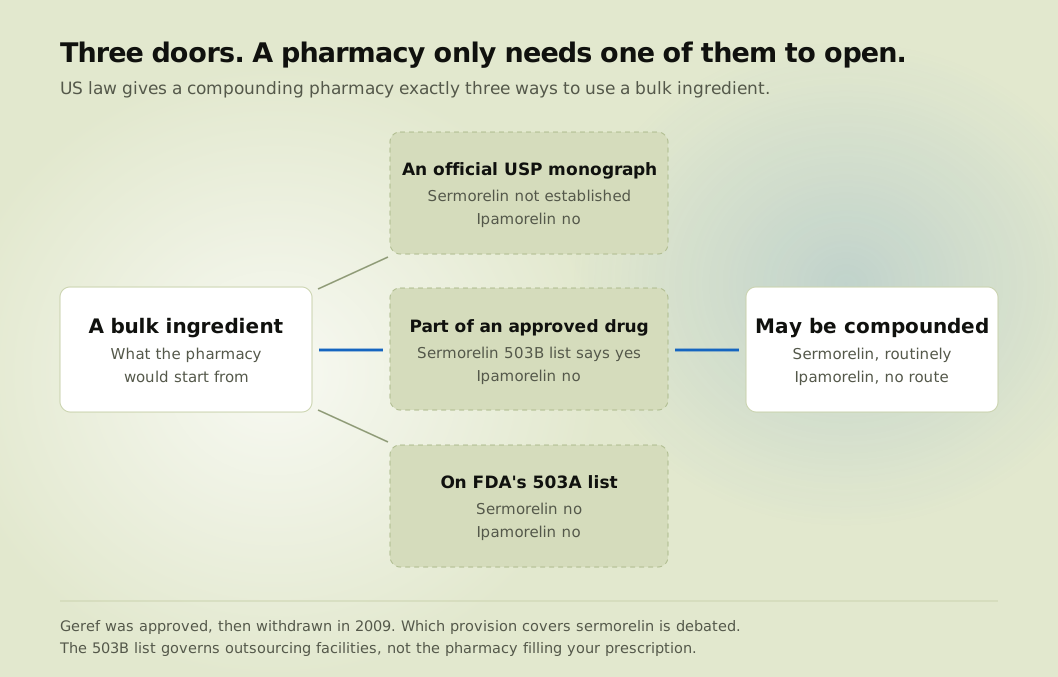
A 503A pharmacy can only work from a raw ingredient if one of three things is true:
- it has an official USP monograph, meaning a published quality standard
- it’s a component of an FDA-approved drug
- it appears on the FDA’s approved list of ingredients for compounding pharmacies, at 21 CFR 216.23
Ipamorelin meets none of them. It has no monograph. It has never been approved as a drug anywhere, by anyone. And that approved-ingredient list contains six substances, none of which is ipamorelin.
Anyone can ask the FDA to add an ingredient to that list, and the agency then reviews it. Someone did ask for ipamorelin. The request was later withdrawn, which stopped the review before it reached a decision, and as of the FDA’s list updated 14 May 2026 ipamorelin no longer appears anywhere in that review process.
Separately, on the 503B side, ipamorelin acetate sits on a different FDA list altogether: substances that “may present significant safety risks” when compounded. It was added to that one on 29 September 2023.
Watch what you’re told about this. Several sites now present ipamorelin dropping off the review list in 2026 as good news, as though a restriction had been lifted. It wasn’t. It came off because the request to approve it was withdrawn, which ends the review rather than passing it. A withdrawn request can’t reach the approved list at all.
That said, sermorelin’s position is different. It was an FDA-approved drug, marketed as Geref. The maker stopped selling it and the approval was withdrawn in 2009, and the FDA has stated in writing that this was not for reasons of safety or effectiveness. Although Geref is gone, the FDA’s separate 503B list still marks sermorelin acetate as a component of an approved drug (FDA, 2025). That list governs outsourcing facilities rather than the 503A pharmacy that fills your individual prescription, so it counts in sermorelin’s favor. What isn’t in doubt: pharmacies compound sermorelin routinely. For ipamorelin, none of the three doors is open at all. (Checked 4 September 2026.)
CJC-1295, and the two versions nobody separates
CJC-1295 usually shows up stacked with ipamorelin (FDA, 2024), and the reason goes back to the two doorways. CJC-1295 works the sermorelin way, on the GHRH receptor. Ipamorelin works the ghrelin way. Push both at once, the theory goes, and you get more growth hormone than either would give you alone. No human trial has tested that combination.
There are two different molecules. CJC-1295 DAC carries a modification that binds it to albumin in your blood, stretching its half-life to roughly six to eight days. CJC-1295 without DAC doesn’t have that, which makes it a short-acting GHRH analog, much closer to sermorelin. The FDA treats them as separate substances with separate registry numbers and states they “are not interchangeable.”
Here’s the part worth knowing. The human data everyone quotes, the 2- to 10-fold growth hormone rise and the multi-day IGF-1 elevation, comes from studies of the DAC version (Teichman et al., 2006). The FDA found no clinical safety or effectiveness data for the non-DAC forms at all. So when a clinic sells you the version without DAC and quotes those growth hormone numbers, those numbers were measured on the DAC version. We go through both versions in CJC-1295 vs sermorelin.
Those studies were also small, mostly male, in healthy volunteers rather than patients, and most participants received a single injection. Injection-site reactions were the most common side effect, and flushing was dose-dependent. A separate trial in patients with HIV-associated fat redistribution was terminated after a participant died of a heart attack, which the attending physician judged most likely due to pre-existing coronary disease (FDA, 2024). The trial data themselves were never published (NCT00267527), so that’s as much as anyone can honestly say about it.
What we prescribe, and why
We prescribe sermorelin.
It raises IGF-1, and in healthy older adults it moved body fat, lean mass and thinking-test scores.
It wins on the thing that separates them. It has been studied in people like you, by the route you would use, and a pharmacy can legally make it. Ipamorelin’s only published test of whether it works was in 117 post-surgical patients, for a different purpose entirely and by a route nobody prescribes. No pharmacy has a lawful way to prepare it.
Ipamorelin might work. Honestly, nobody can tell you whether it does.
You can see what sermorelin at TestDepot costs before you start.
Wellness & Longevity
Sermorelin
Prescribed by our clinicians as part of wellness and longevity care. Prompts your own pituitary to release growth hormone rather than replacing it.
From $259 every 6 weeks
Florida residents only.
FAQ
Can you take sermorelin and ipamorelin together?
Sermorelin and ipamorelin are often sold in the same vial, on the logic that hitting both receptors beats hitting one. The FDA’s own review records ipamorelin being marketed in combination with sermorelin (FDA, 2024). No human trial has tested that combination for any outcome. We don’t prescribe the combination.
Which one is better for sleep?
Honestly, neither has earned that claim, and the sermorelin story is more interesting than the marketing.
There is real sleep research on GHRH, and it is often quoted as if it settled the matter. What it actually shows: deep sleep increased in seven male volunteers given four separate injections into a vein, overnight, in a sleep laboratory (Steiger et al., 1992). In women, the same approach ran the other way and the authors concluded it impairs sleep (Mathias et al., 2007).
For ipamorelin there is no human sleep study at all. If a clinic promises better sleep from either drug, ask which trial says so.
Is ipamorelin legal?
Ipamorelin isn’t a controlled substance, so owning it isn’t the problem. What no pharmacy can do is legally make it for you, because it has no USP monograph, no FDA approval history, and no place on FDA’s approved bulk-substance list. Products still circulate, frequently labeled “research use only,” which is a different supply chain from a licensed pharmacy.
What is the strongest growth hormone peptide?
Between sermorelin and ipamorelin, nobody can tell you, because no trial has ever compared the two directly. Strength claims come from comparing numbers across studies that used different people, doses, routes and endpoints, which is not a comparison. What can be said: ipamorelin stays in the blood longer, and sermorelin has more human evidence in the people these drugs are actually sold to. Neither has been shown to outperform the other at anything.
What works better than sermorelin?
No trial has put sermorelin head to head with ipamorelin or tesamorelin, so neither has been shown to beat it at raising your own growth hormone. Growth hormone itself raises it more directly, because you inject the hormone instead of prompting your own, and it carries a different risk profile and a different price. Tesamorelin has evidence for one HIV-related condition, and that is all. No pharmacy can make it either, because the FDA counts it as a biologic. We cover that in sermorelin vs tesamorelin.
What’s the difference between CJC-1295 with and without DAC?
DAC is a modification that binds the peptide to albumin in your blood. That stretches it to around six to eight days, against the short window of an unmodified GHRH analog. The FDA treats the two as separate, non-interchangeable substances. The published human data is on the DAC version; the non-DAC version has no published human data at all.
Related reading
- CJC-1295 vs sermorelin: a modified version of the signal sermorelin copies, and what it has been measured doing.
- Sermorelin vs TRT: two different hormones, and why plenty of men end up on both.
- Sermorelin vs tesamorelin: a close relative of sermorelin that’s FDA-approved today, for one condition.
- Sermorelin: what we actually prescribe, what it costs, and how it’s dispensed.
- Our clinicians: who reviews and prescribes, with license and NPI details.
References
- FDA Briefing Document, Pharmacy Compounding Advisory Committee meeting, 29 October 2024. US Food and Drug Administration. Source for ipamorelin’s mechanism, the absence of subcutaneous route data, the effectiveness review, the safety findings and the medical-spa marketing note.
- Prospective, randomized, controlled, proof-of-concept study of the ghrelin mimetic ipamorelin for the management of postoperative ileus in bowel resection patients. Beck DE, Sweeney WB, McCarter MD. International Journal of Colorectal Disease, 2014;29(12):1527-1534. Dosed 0.03 mg/kg intravenously twice daily. Primary endpoint, time to tolerating solid food: 25.3 hours against 32.6 on placebo, hazard ratio 1.34, 95% CI 0.90 to 1.98, p = 0.15. Secondary endpoints: first bowel movement p = 0.18, ready for discharge p = 0.35, length of stay p = 0.29. Low potassium 12.5% against 3.4%, insomnia 10.7% against 5.2%.
- Ipamorelin, the first selective growth hormone secretagogue. Raun K, Hansen BS, Johansen NL, et al. European Journal of Endocrinology, 1998;139(5):552-561. Source of the selectivity data, measured in cell culture, rats and swine.
- Pharmacokinetic-pharmacodynamic modeling of ipamorelin, a growth hormone releasing peptide, in human volunteers. Gobburu JV, Agersø H, Jusko WJ, Ynddal L. Pharmaceutical Research, 1999;16(9):1412-1416. The only human pharmacology study, intravenous route.
- Prolonged stimulation of growth hormone (GH) and insulin-like growth factor I secretion by CJC-1295, a long-acting analog of GH-releasing hormone, in healthy adults. Teichman SL, Neale A, Lawrence B, et al. Journal of Clinical Endocrinology and Metabolism, 2006;91(3):799-805.
- FDA Briefing Document, Pharmacy Compounding Advisory Committee: CJC-1295. US Food and Drug Administration, November 2024. Source for the with-DAC and without-DAC distinction and for the terminated trial’s investigator assessment.
- Phase 2 study of CJC-1295 in HIV-associated visceral obesity. ClinicalTrials.gov, NCT00267527. Terminated; no results published.
- Growth hormone (GH)-releasing hormone-(1-29) twice daily reverses the decreased GH and insulin-like growth factor-I levels in old men. Corpas E, Harman SM, Piñeyro MA, Roberson R, Blackman MR. Journal of Clinical Endocrinology and Metabolism, 1992;75(2):530-535. Ten healthy older men. Fasting glucose, urinary C-peptide, blood pressure and chemistry panels were unaffected.
- Treating age-related changes in somatotrophic hormones, sleep, and cognition. Vitiello MV, Schwartz RS, Moe KE, Mazzoni G, Merriam GR. Dialogues in Clinical Neuroscience, 2001;3(3):229-236. Source of the IGF-1 and body-composition figures for nightly sermorelin acetate in healthy older adults. The investigators reported these as preliminary while the trial was still running; a full results paper was never published.
- Growth hormone releasing hormone improves the cognition of healthy older adults. Vitiello MV, Moe KE, Merriam GR, Mazzoni G, Buchner DH, Schwartz RS. Neurobiology of Aging, 2006;27(2):318-323. Six-month randomized placebo-controlled trial, 89 adults, mean age 68. Endpoints were processing-speed and executive tasks, not memory.
- Incorporation of D-Ala2 in growth hormone-releasing hormone-(1-29)-NH2 increases the half-life and decreases metabolic clearance in normal men. Soule S, King JA, Millar RP. Journal of Clinical Endocrinology and Metabolism, 1994;79(4):1208-1211. Source of the 4.3-minute intravenous half-life of unmodified GHRH(1-29), which is sermorelin. The paper’s subject is a modified analog, which lasted longer.
- Effects of growth hormone-releasing hormone and somatostatin on sleep EEG and nocturnal hormone secretion in male controls. Steiger A, et al. Neuroendocrinology, 1992;56(4):566-573. Seven male volunteers, four injections into a vein overnight; slow-wave sleep rose from 14.0% to 20.2%.
- Systemic growth hormone-releasing hormone (GHRH) impairs sleep in healthy young women. Mathias S, et al. Psychoneuroendocrinology, 2007;32(8-10):1021-1027. The same approach in women ran in the opposite direction.
- List of bulk drug substances that can be used to compound under section 503A, 21 CFR 216.23. Electronic Code of Federal Regulations. Checked 4 September 2026: six substances listed, ipamorelin absent.
- Bulk Drug Substances Nominated for Use in Compounding Under Section 503A. US Food and Drug Administration, updated 14 May 2026. Checked 4 September 2026: ipamorelin appears in none of the three categories.
- Bulk Drug Substances Nominated for Use in Compounding Under Section 503B. US Food and Drug Administration, updated 21 March 2025. Page 6 lists “Sermorelin Acetate” with the footnote defined on page 3 as “components of FDA approved drugs”. This list governs outsourcing facilities, not the 503A pharmacy filling an individual prescription.
- Certain Bulk Drug Substances for Use in Compounding that May Present Significant Safety Risks. US Food and Drug Administration. Checked 4 September 2026: ipamorelin acetate listed under section 503B, added 29 September 2023.
- Polyethylene glycol-conjugated growth hormone-releasing hormone is long acting and stimulates GH in healthy young and elderly subjects. Munafo A, Nguyen TX, Papasouliotis O, Lécuelle H, Priestley A, Thorner MO. European Journal of Endocrinology, 2005;153(2):249-256. Twelve young men given single doses and twenty adults over 60 given repeated doses. Source of the finding, in the abstract’s words, that “some impairment of glucose tolerance was observed in the elderly following repeated administration.”
- EGRIFTA WR (tesamorelin for injection) prescribing information. US Food and Drug Administration, revised March 2025. Source of the contraindication in active malignancy, the requirement that a preexisting malignancy be inactive and its treatment complete, and the careful-evaluation warning for a treated, stable cancer.
- Genotropin (somatropin) prescribing information. Pfizer. Source of the growth hormone class contraindication in active malignancy and of the requirement that a preexisting malignancy be inactive and its treatment complete before therapy begins.
- Compounding and the FDA: Questions and Answers. US Food and Drug Administration. Checked 14 September 2026. Source of the quoted statement that “Biological products are not eligible for the exemptions for compounded drugs under sections 503A and 503B of the FD&C Act,” which is why no pharmacy has a route to tesamorelin.
- List of Approved NDAs for Biological Products That Were Deemed to be BLAs on March 23, 2020. US Food and Drug Administration. Lists tesamorelin acetate (Egrifta, NDA 022505, Theratechnologies) among the approved drug applications converted to biologic licenses on that date. Checked 14 September 2026.
- Khorram O, Laughlin GA, Yen SS. Endocrine and metabolic effects of long-term administration of [Nle27]growth hormone-releasing hormone-(1-29)-NH2 in age-advanced men and women. Journal of Clinical Endocrinology and Metabolism, 1997;82(5):1472-1479. Nineteen adults aged 55 to 71, nightly subcutaneous injection for five months. The drug is a close analog of sermorelin, not sermorelin itself. Verbatim: “The only adverse side-effect was transient hyperlipidemia, which resolved by the end of the study.”
- Determination that GEREF (sermorelin acetate) injection was not withdrawn from sale for reasons of safety or effectiveness. Federal Register, 78 FR 14095, 4 March 2013.
This article is for general information and is not individual medical advice. Sermorelin is a prescription medicine; whether it is appropriate for you depends on your labs, your history and a clinician’s judgment. Talk to a clinician before starting or stopping any treatment.