If you’re comparing these two, you’ve probably noticed something odd. Almost nobody sells CJC-1295 by itself. It shows up bundled with a second peptide called ipamorelin, and the pitch is that the pair does more than sermorelin can on its own.
That pitch has real numbers behind it. The numbers also have a problem most pages quoting them leave out.
Short version
- Sermorelin is a nightly injection that tells your pituitary to release more of your own growth hormone. In men taking it that way it raised IGF-1, the blood marker that tracks how much growth hormone you’re making, by about 40%. Body fat fell and lean mass rose.
- In a six-month trial in 89 older adults, sermorelin beat placebo on five separate tests of thinking: problem solving, attention, visual scanning, verbal fluency and switching between two tasks.
- You can get sermorelin from a licensed pharmacy, legally.
- CJC-1295’s published growth hormone numbers are bigger than sermorelin’s, and it holds the level up for days rather than hours. Two different molecules are sold as CJC-1295, and the human results were measured on only one of them.
- No US pharmacy has a lawful route to compound CJC-1295 or ipamorelin.
- No published human trial has tested CJC-1295 and ipamorelin together, which is the pairing sold in a single vial.
- Ipamorelin’s half of that pairing works through a receptor that fades. Hexarelin, a close relative, lost 45% of its growth hormone effect over sixteen weeks of twice-daily dosing, and got all of it back after four weeks off. Sermorelin works on the GHRH receptor, and in the rat experiment that tested both, that response held.
What each one is, and what it’s for
Sermorelin is the first 29 amino acids of growth hormone-releasing hormone, or GHRH, the signal your brain already sends your pituitary every night. That fragment is the part that does the releasing. You inject a small dose under the skin at bedtime, your pituitary responds, and your own growth hormone goes up. We prescribe it as part of wellness and longevity care.
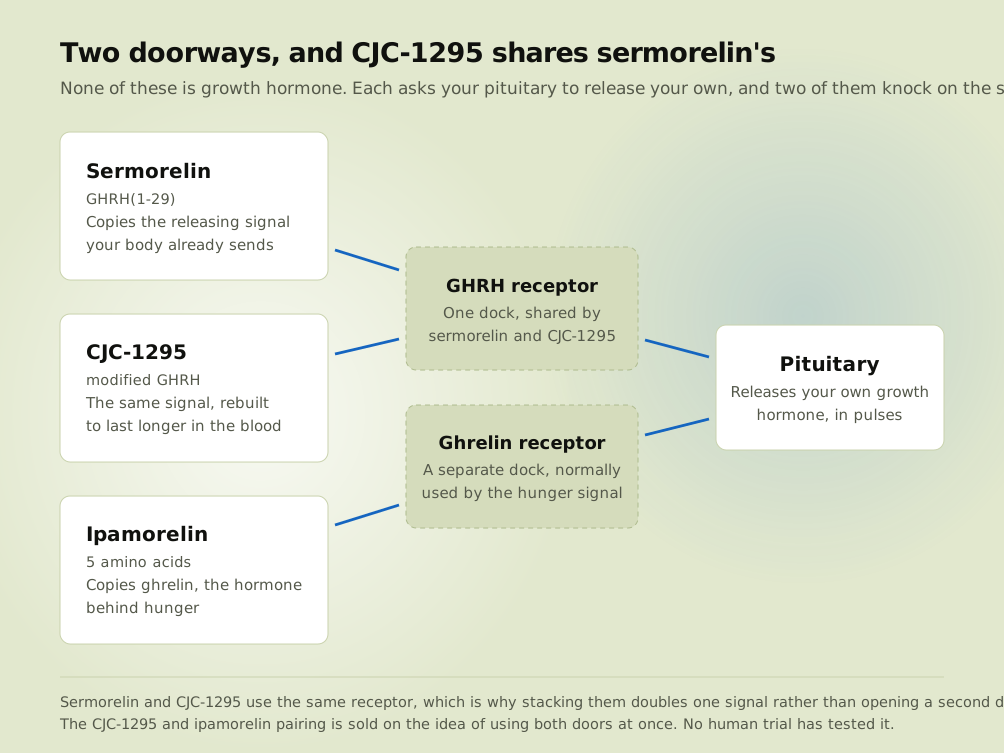
CJC-1295 is a modified version of that same GHRH signal, redesigned to survive longer in your blood. Here’s the thing almost every product page blurs: two different molecules are sold under the name.
CJC-1295 with DAC carries an extra chemical handle, the drug affinity complex the initials stand for, which latches onto albumin, a protein circulating in your blood. That stretches its half-life to roughly six to eight days. CJC-1295 without DAC has no such handle. The FDA describes it as short-acting, much closer to sermorelin. The agency holds the two CJC-1295 forms as separate substances with separate registry numbers, and states plainly that they “are not interchangeable.”
Ipamorelin is not a version of either one. Ghrelin is the hormone best known for making you hungry, and ipamorelin works on its receptor: a completely different doorway into the same pituitary cell. We cover it in sermorelin vs ipamorelin.
Why CJC-1295 is almost never prescribed alone
The theory behind the stack is that you’re opening two doors at once. CJC-1295 knocks on the GHRH receptor the way sermorelin does, ipamorelin knocks on the ghrelin receptor, and pushing both is supposed to produce a bigger release than either manages alone.
That’s a reasonable idea, and it’s why CJC-1295 and ipamorelin are sold in a single vial. Granted, a reasonable idea and a tested one are different things. No published human trial has tested CJC-1295 and ipamorelin together, for any outcome. So when a clinic tells you the stack outperforms sermorelin, they’re reasoning from mechanism, not reporting a result.
The catch is that second doorway. The ghrelin receptor doesn’t stay put. Once something binds to it, the receptor pulls back into the cell within about twenty minutes, and takes around six hours to return. Keep hitting it and the same dose does less.
You can watch that happen. Twelve healthy older adults injected hexarelin, a close relative of ipamorelin, twice a day for sixteen weeks. Their growth hormone response fell 45%, and it was already down 31% after the first week alone. Four weeks off the drug and it came back completely. That is what people mean when they say a peptide has to be cycled.
Sermorelin’s track record is longer, and it’s a different kind of record. The FDA approved it as a treatment, because a trial showed it worked. In that trial 110 growth-hormone-deficient children injected it nightly and their growth rate roughly doubled: 4.1 centimeters a year before treatment, 8.0 at six months, 7.2 at twelve. That’s what an approval is, a regulator agreeing the drug does what it claims.
The animal work points at the same receptor difference. After fifteen days of ipamorelin, rats produced less growth hormone in response to ipamorelin, and the same amount as before in response to GHRH. Sermorelin works on the GHRH receptor, the one still responding. And when children were given GHRH into a vein and then given it again two and a half hours later, the second dose worked as well as the first.
What sermorelin does, measured
IGF-1 goes up, and how much depends on who you are. Doctors track IGF-1 rather than growth hormone itself, because growth hormone comes in pulses too brief to catch, and IGF-1 falls steadily from your twenties onward. In a University of Washington study of nightly sermorelin in older adults, it rose about 40% in men and about 30% in women not taking estrogen replacement. In women on estrogen replacement it rose under 10%.
Body fat fell and lean mass rose. The same study put people through DEXA scanning, the X-ray body scan that separates fat from muscle. Body fat fell by about 5% of what the men were carrying, and lean mass rose to match, with the same result in the women not on estrogen replacement. Both figures come from an interim report of that study.

Older men were brought back to young men’s levels. In a trial giving the same GHRH(1-29) fragment by injection under the skin twice a day for 14 days, growth hormone and IGF-1 in healthy men around 68 rose until they no longer differed from men in their twenties.
Thinking-test scores improved. In a six-month randomized placebo-controlled trial in 89 healthy older adults, the treated group beat placebo on five separate measures: problem solving, attention, visual scanning, verbal fluency, and switching between two tasks.
A close analog improved libido and general well-being. The trial used a molecule that is sermorelin’s own 29-amino-acid sequence with a single amino acid swapped. That molecule is not sermorelin, and the sermorelin trials on this page didn’t ask men how they feel. Everything else about the trial matches how we prescribe: 19 adults aged 55 to 71, injecting themselves under the skin every night for five months, against placebo. The men’s libido improved and so did their general sense of well-being, and their lean body mass rose. The only side effect was a temporary rise in blood fats, cholesterol and triglycerides, which settled before the study ended.
Honestly, there is a limit worth saying plainly. Every trial in this section ran in adults aged roughly 55 and up. What they establish is that IGF-1 falls steadily with age and that sermorelin raises it, and your own number is knowable in a week. That is the reason we test it before writing a prescription instead of predicting what you’ll feel.
What the stack does, measured
Those growth hormone numbers are real, and they’re bigger than anything published for sermorelin.
In twelve healthy men aged 20 to 40, CJC-1295 with DAC raised average growth hormone across the day by 46%, and IGF-1 by 45%. Earlier work in healthy volunteers, testing a range of doses, found growth hormone rising between two and ten times over baseline, with IGF-1 staying elevated for days.
Those studies were small, mostly male, run in healthy volunteers rather than patients, and most participants received a single injection. That single injection was not comfortable. In the earlier of the two studies, 33 of the 35 people given CJC-1295 reported a side effect afterwards, against 2 of the 7 given placebo. Around seven in ten had a reaction where the needle went in, and roughly six in ten had a headache, against fewer than two in ten on placebo.
Every one of those numbers was measured on the version with DAC. For CJC-1295 without DAC, the FDA found no published data at all, clinical or otherwise.
Ipamorelin’s record is shorter. It has been through exactly one randomized trial, in 114 patients, injected into a vein twice a day, testing whether it helped bowel function return after surgery. It didn’t.
What “longer-acting” actually buys you
Start with how long each one lasts. Sermorelin’s European label puts the half-life, the time your body takes to clear half a dose, at six to seven minutes, with the peak response about thirty minutes in and the whole effect lasting two to three hours. Those figures are from a dose given into a vein, which is the only route the label reports. Nobody has published the same measurements for an injection under the skin at bedtime, which is how you’d actually take it, and it is absorbed more slowly that way.
The DAC version works on a completely different scale: a half-life of six to eight days, so a single dose is still working a week later.
A separate trial measured what that does in the body. In twelve healthy men, CJC-1295 with DAC raised trough growth hormone, the baseline level between your natural pulses, by 7.5 times, while the pulses themselves carried on at unchanged frequency and size. So it isn’t reshaping your rhythm. It’s holding the floor higher, around the clock, for days at a stretch. Sermorelin raises your growth hormone during the window your body already does it in, and is gone by morning.
Whether you want growth hormone elevated continuously or only overnight is a real question, and no trial has settled it.
That said, the practical difference is how often you inject. Sermorelin goes in nightly, which is 7 injections a week. Something that stays active for six to eight days needs about 1.

What a US pharmacy can legally make
Compounding is a pharmacy mixing a drug to order from raw ingredients, rather than dispensing one a factory produced. That is how you get sermorelin: no manufacturer makes it in the US any more, so the vial you are prescribed is mixed for you by a pharmacy.
A pharmacy can only work from a raw ingredient if one of three things is true. The ingredient has a published quality standard, called a USP monograph. Or it’s a component of an FDA-approved drug. Or it appears on the FDA’s approved list of ingredients for the kind of pharmacy that mixes a prescription for one specific person.
Sermorelin gets in through the second door. It was approved and sold here as Geref, and its manufacturer stopped selling it for business reasons, not because anything was wrong with it. The FDA has said so on the record: Geref injection was “not withdrawn for reasons of safety or effectiveness.” Pharmacies compound it routinely.
CJC-1295 and ipamorelin get in through none of the three. CJC-1295 alone reaches a pharmacy in several chemical forms, and in late 2024 the FDA proposed leaving five of those forms off the list, citing unclear characterization, safety signals in animal testing, and missing clinical data. Its advisory committee then rejected the three long-acting versions 13 to nothing. The FDA proposed the same for ipamorelin, and the agency noted there are no safety data for it at all by injection under the skin, which is how patients take it. Granted, no final rule has been issued, so the proposal is not itself a completed ban. It doesn’t need to be: neither molecule meets any of the three routes today. (Checked 10 September 2026.)
| Published quality standard | Component of an approved drug | On the 503A list | |
|---|---|---|---|
| Sermorelin | No | Yes, Geref | Not needed |
| CJC-1295 | No | No | No, proposed against |
| Ipamorelin | No | No | No, proposed against |
Which one you actually need
We prescribe sermorelin.
What you’d be buying is a nightly injection that raises your own growth hormone output. The body-fat results, and the 40% IGF-1 rise, came from people injecting it under the skin at bedtime, the way you would.
It’s also the only one of these three you can legally have made.
The catch is blood sugar, and two trials have measured it. The five-month trial of the close sermorelin analog found insulin sensitivity improving in the men. A 14-day trial of the GHRH fragment itself, in older men, found no effect on fasting glucose at all. Growth hormone does work against insulin, though, so we test your blood sugar before you start instead of assuming.
One thing rules people out. Growth hormone is a growth factor, and the drugs in this family that have current FDA prescribing information, tesamorelin and growth hormone itself, say the same thing: not for anyone with an active cancer. A cancer you’ve been treated for is a different question. The labels ask that it be inactive and the treatment finished, and that a doctor weigh it up with you first. The same reasoning applies to CJC-1295 and ipamorelin, but neither has an approved label, so nobody has written the rule down for them at all.
Starting with us takes two things: blood work, and an appointment with a provider. Not a questionnaire, and not labs on their own. We check your IGF-1 before writing a sermorelin prescription and again once you’re on it, so you can see where you started and whether it moved.
Wellness & Longevity
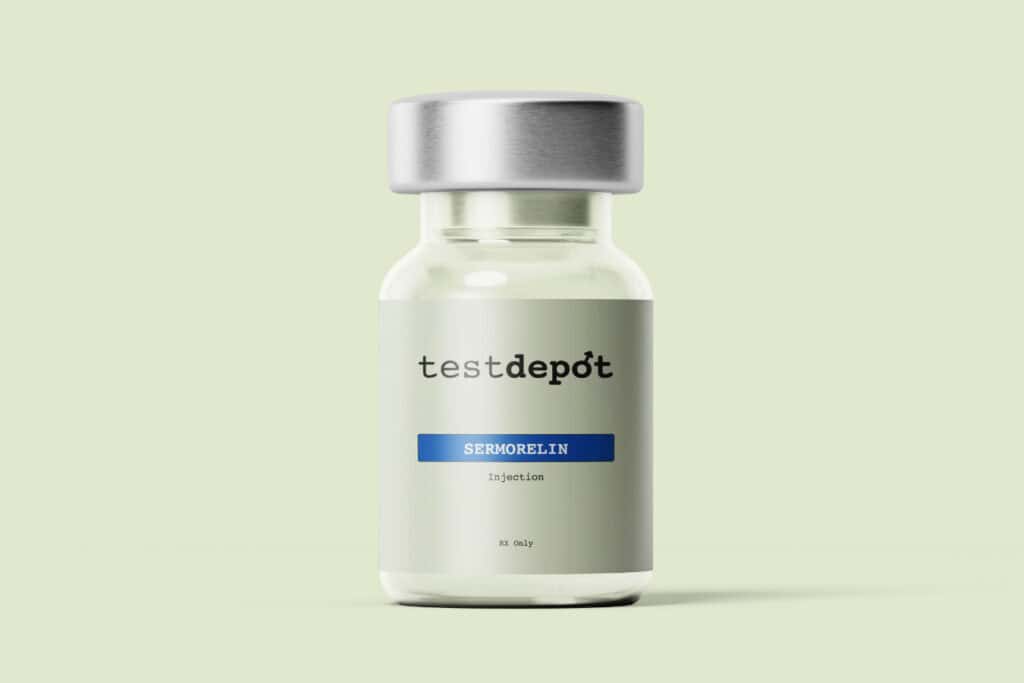
Sermorelin
Prescribed by our clinicians as part of wellness and longevity care. Prompts your own pituitary to release growth hormone rather than replacing it.
From $259 every 6 weeks
Florida residents only.
FAQ
Which is better for me, sermorelin or CJC-1295 with ipamorelin?
On the evidence available to you, sermorelin. It has human trials by the route you’d use, and a
pharmacy can legally make it. That said, here’s what the stack would actually be giving you: a
bigger growth hormone rise, measured on one of the two CJC-1295 molecules, in a pairing no
trial has tested.
What’s better, sermorelin, ipamorelin or tesamorelin?
They answer different questions. Tesamorelin is the only one with a current FDA approval, and
it covers reducing belly fat in adults with HIV-associated lipodystrophy. We compare each pair
in sermorelin vs tesamorelin and
sermorelin vs ipamorelin.
Can you take CJC-1295 and sermorelin together?
Sermorelin and CJC-1295 act on the same receptor, so stacking them pushes harder on one door
rather than opening a second. The CJC-1295 and ipamorelin pairing is a different proposition, and we prescribe
neither combination.
How long before I notice anything on sermorelin?
The trials that measured body composition and cognition ran five to six months. IGF-1 moves
sooner and is what your follow-up bloodwork looks at. No adult trial here has run past six
months.
Related reading
References
- Effects of [Nle27]growth hormone-releasing hormone-(1-29)-NH2 administration on the growth hormone-insulin-like growth factor axis and body composition in older men and women. Journal of Clinical Endocrinology and Metabolism, 1997;82(5):1472-1479. Source of the libido, well-being, lean body mass, insulin sensitivity and blood lipid findings, and of the five-month placebo-controlled design in 19 adults aged 55 to 71.
- Growth hormone-releasing hormone administration in healthy older adults. Vitiello et al., 2001. Source of the IGF-1 rise of about 40% in men and about 30% in women not on estrogen replacement, of the under-10% figure in women on estrogen replacement, and of the DEXA body fat and lean mass results reported while the trial was still running.
- Growth hormone releasing hormone improves the cognition of healthy older adults. Neurobiology of Aging, 2006;27(2):318-323. Source of the six-month randomized placebo-controlled trial in 89 healthy older adults, the five cognitive measures that beat placebo, and the finding that the improvements were independent of gender, estrogen status and baseline cognitive capacity.
- Growth hormone (GH)-releasing hormone-(1-29) twice daily reverses the decreased GH and insulin-like growth factor-I levels in old men. Corpas, Harman, Pineyro, Roberson and Blackman, Journal of Clinical Endocrinology and Metabolism, 1992;75(2):530-535. Source of the finding that GHRH(1-29) given subcutaneously twice daily for 14 days raised growth hormone and IGF-1 in healthy old men until they no longer differed from young men, and of the finding that treatment did not affect fasting glucose.
- Pulsatile secretion of growth hormone (GH) persists during continuous stimulation by CJC-1295, a long-acting GH-releasing hormone analog. Ionescu and Frohman, Journal of Clinical Endocrinology and Metabolism, 2006;91(12):4792-4797. Source of the 46% mean growth hormone rise, the 45% IGF-1 rise, the 7.5-fold increase in trough growth hormone, and the finding that pulse frequency and magnitude were unaltered.
- Prolonged stimulation of growth hormone (GH) and insulin-like growth factor I secretion by CJC-1295, a long-acting analog of GH-releasing hormone, in healthy adults. Journal of Clinical Endocrinology and Metabolism, 2006;91(3):799-805. Source of the two- to ten-fold growth hormone rise, the multi-day IGF-1 elevation, and the injection-site reactions in healthy volunteers.
- FDA Briefing Document, Pharmacy Compounding Advisory Committee: evaluation of five CJC-1295-related bulk drug substances. US Food and Drug Administration, December 2024. Source of the with-DAC and without-DAC distinction, the six to eight day half-life of the DAC form, the absence of any USP monograph or approved-drug component status, the proposal not to add the substances to the 503A bulks list, the animal safety signals, and the adverse-event rates reported for the Teichman studies, including the 33 of 35 on drug against 2 of 7 on placebo.
- FDA Briefing Document, Pharmacy Compounding Advisory Committee: ipamorelin. US Food and Drug Administration, October 2024. Source of the proposal not to add ipamorelin to the 503A bulks list and of the absence of safety data by the subcutaneous route.
- Prospective, randomized, controlled, proof-of-concept study of the ghrelin mimetic ipamorelin for the management of postoperative ileus in bowel resection patients. Beck et al., International Journal of Colorectal Disease, 2014;29(12):1527-1534. Source of the single randomized ipamorelin trial, its intravenous route, its 114 analyzed patients and its negative result.
- Geref 50 Summary of Product Characteristics. Health Products Regulatory Authority, Ireland, marketing authorisation PA 285/6/1. Source of sermorelin’s six to seven minute intravenous plasma half-life, the thirty-minute peak response and the two to three hour duration.
- Determination that GEREF (sermorelin acetate) injection was not withdrawn from sale for reasons of safety or effectiveness. Federal Register, 78 FR 14095, 4 March 2013. Source of the statement that Geref was not withdrawn for safety or effectiveness reasons.
- Bulk Drug Substances Used in Compounding Under Section 503A. US Food and Drug Administration. Source of the three routes by which a compounding pharmacy may use a bulk drug substance.
- Pharmacy Compounding Advisory Committee meeting transcript, 4 December 2024. US Food and Drug Administration. Source of the committee’s votes on the three CJC-1295 DAC substances, each rejected 13 to nothing with no votes in favor and no abstentions.
- Ipamorelin, a new growth-hormone-releasing peptide, induces longitudinal bone growth in rats. Johansen et al., Growth Hormone and IGF Research, 1999;9(2):106-113. Source of the finding that rats given ipamorelin three times daily for 15 days showed a reduced growth hormone response to ipamorelin, and an unchanged response to GHRH.
- Desensitization and endocytosis mechanisms of ghrelin-activated growth hormone secretagogue receptor 1a. Camina et al., Endocrinology, 2004;145(2):930-940. Source of the finding that the receptor withdraws from the cell surface within about twenty minutes of binding and takes roughly six hours to recover.
- Growth hormone status during long-term hexarelin therapy. Rahim, O’Neill and Shalet, Journal of Clinical Endocrinology and Metabolism, 1998;83(5):1644-1649. Source of the 45% fall in the growth hormone response across sixteen weeks of twice-daily subcutaneous hexarelin in twelve healthy older adults, of the loss already present at one week, and of its full recovery after four weeks off the drug.
- EGRIFTA WR (tesamorelin for injection) prescribing information. US Food and Drug Administration, revised March 2025. Source of the contraindication in active malignancy and of the requirement that a preexisting malignancy be inactive and its treatment complete before therapy begins.
- Once daily subcutaneous growth hormone-releasing hormone therapy accelerates growth in growth hormone-deficient children during the first year of therapy. Thorner et al., Geref International Study Group, Journal of Clinical Endocrinology and Metabolism, 1996;81(3):1189-1196. Source of the trial giving 110 growth-hormone-deficient children nightly subcutaneous sermorelin for up to a year, and of the mean height velocity rising from 4.1 cm/yr at baseline to 8.0 at six months and 7.2 at twelve.
- Genotropin (somatropin) prescribing information. Pfizer. Source of the growth hormone class contraindication in active malignancy and of the requirement that a preexisting malignancy be inactive and its treatment complete before therapy begins.
- The negative GH auto-feedback in childhood: effects of rhGH and/or GHRH on the somatotroph response to GHRH or hexarelin, a peptidyl GH secretagogue, in children. Bellone et al., Journal of Endocrinological Investigation, 2000;23(3):158-162. Source of the finding that a dose of GHRH given two and a half hours after an earlier dose produced the same growth hormone response as one given after saline.
Medically reviewed by Lewis Spangler, MD, Medical Director. This article is general information about prescription treatments and is not individual medical advice. Whether any of these treatments is appropriate for you depends on your history, your examination and your blood work, and that is a decision for you and a licensed provider.